
Leaders and professionals can usually articulate their organization’s values with ease. Sometimes they are clearly stated in decks and posters. Other times, they are revealed through everyday decisions and behaviors.
There is extensive research on why values matter. They form the foundation of culture in any human system, shaping identity, coherence, and performance. Many HR and Talent leaders have embedded values across the employee lifecycle, from hiring to development and succession. At their best, these efforts help organizations clarify what truly matters.
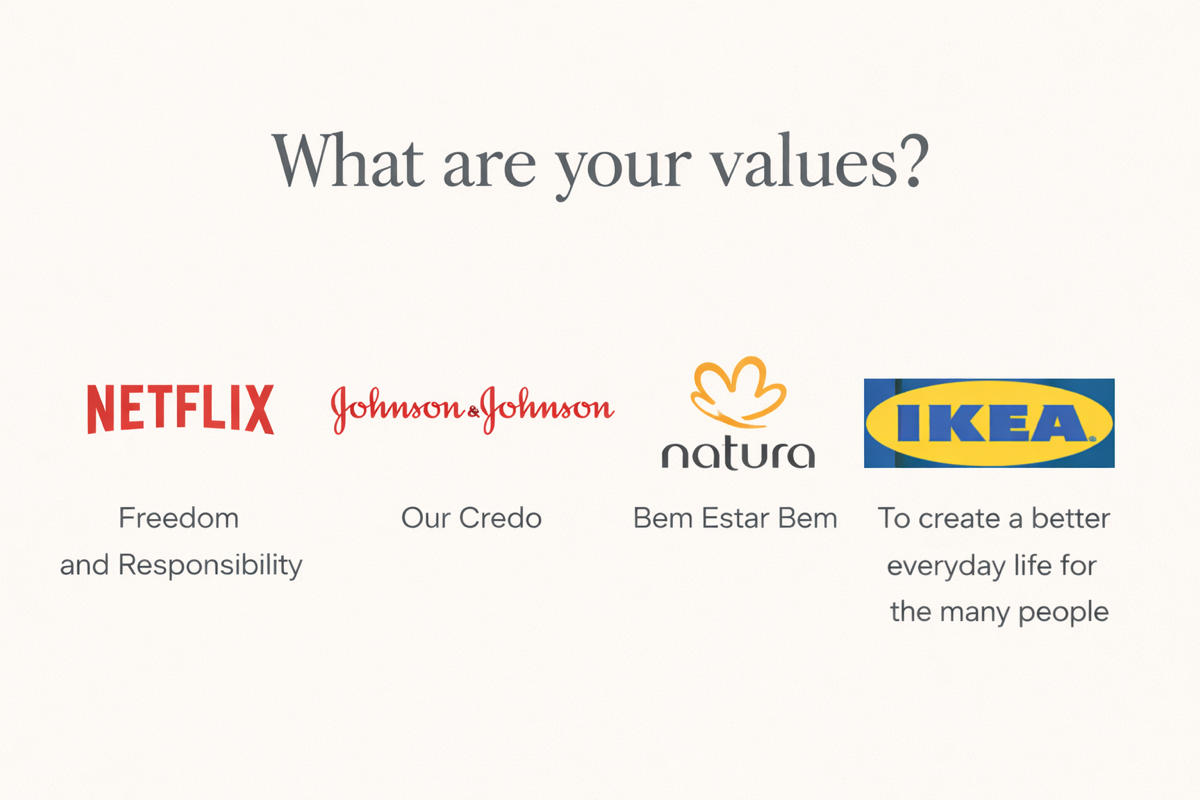
Some value statements I admire for their clarity include:
- Netflix: “Freedom and Responsibility”
- Johnson & Johnson: “Our Credo”
- Natura: “Bem Estar Bem” (well-being and being well)
- IKEA: “To create a better everyday life for the many people”
All of this is important. And yet, a more personal question often goes unasked:
What are your values?
What do you personally hold to be non-negotiable? How do those values show up in your work, your relationships, and your life outside of work?
It is surprisingly uncommon to hear people clearly articulate their own moral compass. For some, religion provides that clarity. For many others, values remain implicit, inherited, or shaped by external expectations rather than consciously chosen.
Richard Boyatzis’ Intentional Change Theory makes this explicit: sustained, intentional change requires clarity of personal values and a vision of the future that feels meaningful. Without that clarity, change tends to be reactive, short-lived, or misaligned. In Resonant Leadership, Richard Boyatzis and Ellen Van Oosten offer a simple but powerful exercise to help individuals and groups surface and prioritize what they truly value.
Over time, I have come to see that when people struggle at work, it is rarely due to lack of capability or effort. More often, it reflects a quiet misalignment between what they value and how work is designed around them, including what is rewarded by leaders and systems.
When you are clear about your own values, you can see alignment and misalignment more objectively. That clarity does not make choices easier, but it makes them more honest.
When I recently revisited my own values using this exercise, what struck me most was not what appeared, but what did not. Some values I assumed were central turned out to be contextual. Others, quieter and less celebrated, showed up consistently across my decisions and trade-offs. That insight has since become a functional compass, especially when navigating ambiguity, change, and competing demands.
This continues to shape how I think about leadership, performance, and the design of work at Unmaze.
Bonus: Want to explore your values more deeply?
If you would like a structured way to reflect on your personal values and strengths, a good starting point is the VIA Character Strengths assessment, offered by the nonprofit VIA Institute on Character. It is research-based, accessible, and free, and it provides a thoughtful foundation for reflection.
If you would like to go a step further, I am also happy to share the values clarification exercise developed by Richard Boyatzis and Ellen Van Oosten, which I referenced above and regularly use in my own reflection and coaching work.
You can also request the exercise through a short form below. Once submitted, the exercise will be sent directly to your email. If you choose to work with it, I would be curious to hear what stands out for you and how it informs the choices ahead.
Thiago Licias de Oliveira – Founder of Unmaze