
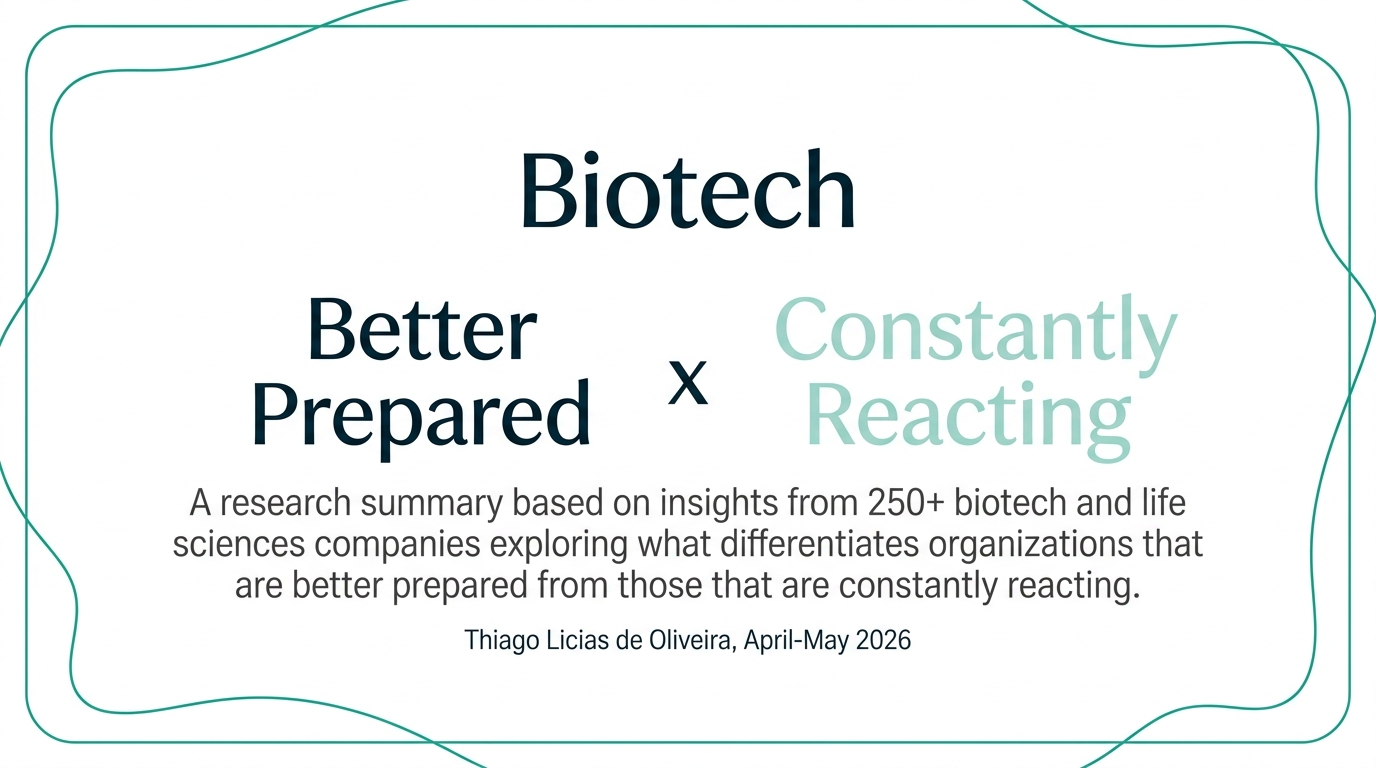
The Question That Sparked This Research
Over the past year, I have had the opportunity to advise biotech founders, CEOs, HR leaders, and investors as they navigate some of the most consequential transitions in the life sciences industry.
Companies are preparing for clinical readouts, scaling after financing rounds, reshaping innovation portfolios, building commercial capabilities, and, increasingly, trying to understand what artificial intelligence means for how they operate.
As I listened to these leaders, one question kept surfacing:
What differentiates organizations that are better prepared from those that are constantly reacting?
This question became the foundation for a research study I conducted as part of the Master of Leadership and Organizational Change (MLOC) at Case Western Reserve University.
Why This Matters Now
Biotech organizations face extraordinary complexity. Scientific innovation alone is no longer enough. Leadership teams must simultaneously:
- Advance breakthrough science
- Navigate regulatory uncertainty
- Preserve cash and extend runway
- Build commercial capabilities
- Integrate external partners
- Attract and retain exceptional talent
- Prepare for the disruptive potential of AI
In this environment, the challenge is often not a lack of intelligence, commitment, or capital. The challenge is organizational alignment.
How work is structured.
How decisions are made.
How priorities are set.
How accountability is distributed.
How leaders and teams focus their energies.
In short, how execution happens.
Research Methodology
This study was conducted in April 2026 using a confidential survey distributed to leaders across the biotech and life sciences ecosystem.
- 250+ responses were received, of which 50 responses were prioritized for deeper qualitative analysis.
- Respondents included founders, CEOs, CHROs, HR leaders, and business operators.
- Companies ranged from early-stage ventures to publicly traded commercial organizations.
The study explored how organizations are navigating:
- Scaling and development
- Restructuring
- Commercialization readiness
- Leadership transitions
- AI adoption
What We Learned
After reviewing the responses, one conclusion became increasingly clear:
Prepared organizations do not react to complexity. They intentionally design how work, decisions, and execution happen.
These organizations are deliberate in addressing predictable pain points as they prepare for their next inflection point.
- They Focus on Fewer, Clearer Priorities
Reactive organizations are busy but not always focused.
Prepared organizations make explicit choices about what matters most over the next six to twelve months and align resources accordingly.
“We are busy all the time, but I’m not sure we’re focused on the right things.”
- They Distribute Decision-Making
As organizations scale, centralized decision-making becomes a bottleneck.
Prepared organizations clarify decision rights and push authority closer to where expertise resides.
“Everything still needs to go through the founders.”
- They Redesign Work to Leverage AI
Many companies are experimenting with AI, but relatively few are changing how work is organized.
Prepared organizations view AI not as a bolt-on tool, but as a catalyst for rethinking roles, workflows, and coordination.
“We are testing AI, but it’s not changing how we work.”
- They Convert Capital into Outcomes
Funding matters, but execution determines whether capital becomes scientific and commercial progress.
Prepared organizations build the management systems needed to translate resources into results.
“Capital is available. Turning it into results is the challenge.”
Where Organizations Struggle Most
Several themes appeared repeatedly across the data:
- Competing priorities
- Decision-making bottlenecks
- Leadership teams staying too close to operational details
- Cross-functional misalignment
- Scaling complexity
- AI experimentation without a coherent redesign of work across value streams
These are not isolated issues. They are predictable signals that the organization has reached a new level of complexity.
Five Questions Biotech Leadership Teams Must Answer
- What truly matters in the next six to twelve months?
- Are we scaling people, or scaling clarity?
- Who makes which decisions, and how fast?
- What would need to change to operate at twice the speed?
- Where is complexity slowing execution today?
Spotlight Case: Axenya
One of the most provocative conversations I had during this research was with Mariano García-Valiño.
Axenya is building a healthcare platform focused on early intervention and real-time clinical intelligence, with AI embedded at the center of its operating model.
Several aspects of Mariano’s approach stood out:
- Minimal management layers to accelerate decision-making
- Work structured around outcomes rather than rigid roles
- AI is integrated directly into day-to-day workflows
- Organizational design is treated as a strategic advantage
As Mariano put it: “Most organizations add AI. Very few redesign for it.”
Axenya offers a glimpse of what may become a new organizational model for life sciences companies.
What This Means for Biotech Innovators and Early-Stage CEOs
The implications are straightforward.
The organizations that appear best prepared are not necessarily the ones with the most funding, the largest teams, or the most advanced science. They are the ones who intentionally design:
- Their priorities
- Their decision-making
- Their operating model
- Their leadership practices
- Their use of AI
In other words, they treat organizational design as a strategic capability.
Related Literature and Influences
The patterns emerging from this research resonate strongly with several works that have shaped our practices at Unmaze:
- Growing Pains
- Managing Corporate Lifecycles
- The Founder’s Dilemmas
- Get Scalable
- The Science of Scaling
Together, these works describe a central idea: as organizations evolve, they encounter predictable challenges that require corresponding changes in leadership, structure, management systems, and ways of working.
Closing Reflection
After studying the results from this survey and listening to the experiences of dozens of Biotech leaders in the past weeks, one insight became increasingly clear:
Life sciences success is breakthrough science, executed with intent.
If these findings resonate, I welcome the opportunity to compare notes with founders, CEOs, CHROs, investors, and operators working to better prepare their organizations for what comes next.